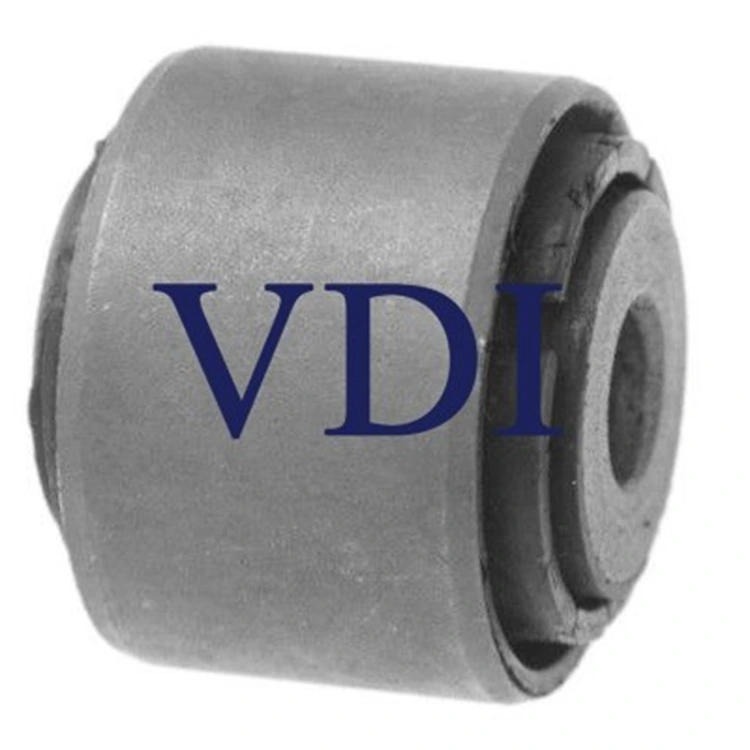

Component fatigue analysis is also divided into two steps: Structural Analysis and Fatigue Analysis.
First, structural analysis of automotive suspension bushings is conducted using Abaqus/Explicit. Based on the bushing numerical model, material properties are assigned, meshing is performed, and loads are applied to calculate and analyze the alternating deformation along the vertical axis within one sine wave cycle.
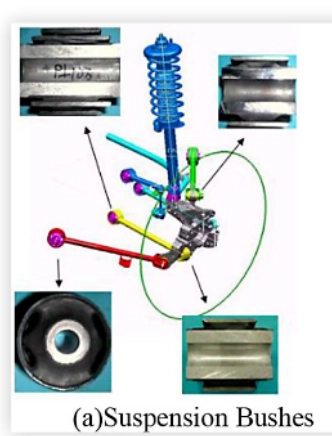
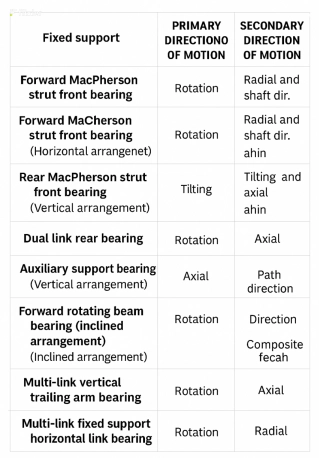
How to apply loads to rubber bushings? Set according to the motion pattern of the rubber bushing.
What are the motion patterns of suspension bushings?
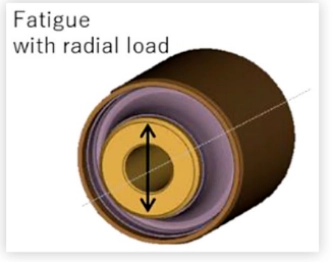
The following figure shows the finite element model of a specific suspension bushing under radial load and the contour plot of the calculation results.

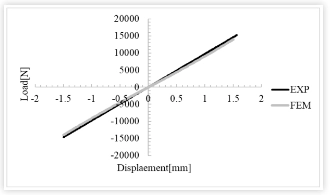
The bushing stiffness curve (force-displacement curve) is compared with experimental results, further proving the validity of the established FEM model. As can be seen from the figure: analysis using hyperelastic parameters identified from material test specimens demonstrates good consistency between experimental and analytical results on the load-displacement diagram.
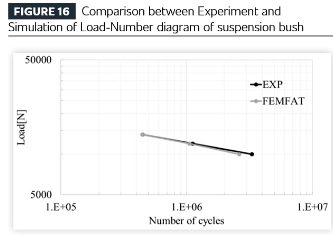
Next, the results of the above structural analysis are transferred to the software's fatigue analysis module (in this case using FEMFAT software from Magna ECS) and compared with durability test results. The test and analysis demonstrate excellent consistency in both fatigue life and crack location.
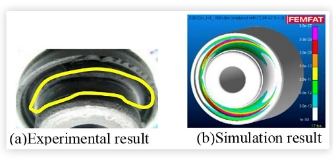
In the test results, cracks propagated in the circumferential direction and initiated from the material zone simultaneously subjected to axial tensile and compressive loads.

The Haigh diagram of the fatigue simulation results for the suspension bushing reveals fracture under compressive stress ratios. Although tensile and compressive loads are applied equally to the rubber material, the analysis indicates that failure ultimately initiates under compression.
Verification and further confirmation have established a rubber component fatigue analysis methodology based on S-N curves and Haigh diagrams.
[Establishing an Efficient Vehicle Product Design Process Through Fatigue Analysis Technology] Applying the proposed fatigue analysis technique for vibration-isolating rubber components, a parametric study was conducted on components made of the same material to investigate the relationship between geometric variation (rubber volume) and durability performance. Component geometry was derived from the original part design, with modeled variations including:
● 15% and 30% increase in outer diameter;
● 15% and 30% increase in both inner and outer diameters;
● 15% and 30% axial elongation of the component.
Loading methods: radial and torsional loads


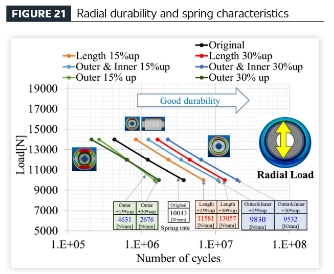
Six distinct geometric configurations and two different loading modes were constructed. The simulation results are summarized as follows:
(1) Radial force loading: six modified shapes plus the original shape.
(2) Torsional displacement loading: six modified shapes plus the original shape.
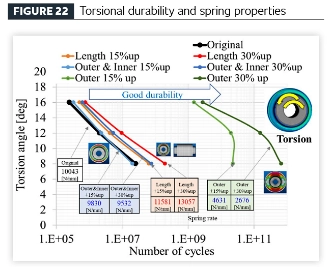
The trend variations from the two figures above are summarized in Table 1: "Performance–Geometry Correlation Table".
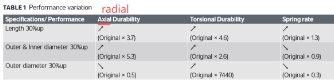
Research conclusions: When only the outer diameter is increased, durability against radial loads decreases, torsional durability improves, and spring performance softens. When both inner and outer diameters are increased, durability under radial loads and torsional loads both improve, while spring performance softens. When axial length is increased, durability under radial loads and torsional loads both improve, and spring performance stiffens.
These findings are compiled in the following "Performance Matrix":

By pre-calculating the durability and spring characteristics of various design variations through automated programs, the accuracy of the performance catalog can be further improved through continuous data updates.
For rubber vibration isolators, performance requirements may aim to achieve an optimal balance between radial load durability and torsional durability, or torsional durability may be of particular importance. Regarding spring characteristics, while a softer spring rate is often desirable for noise, vibration, and ride comfort, relatively stiffer springs are sometimes necessary to ensure handling precision and vehicle stability. Since component design data with defined performance attributes are selected according to whole-vehicle performance targets—and these attributes are intrinsically linked to dimensional parameters—component dimensions can be reverse-engineered starting from desired performance metrics. This approach enables performance targets to be established during the initial conceptual phase of vehicle development, even in the absence of detailed drawings, and allows approximate layouts of rubber components to be derived based on expected performance. By leveraging this performance catalog, component dimensions can be determined from the outset according to performance specifications—eliminating the need for repetitive FEM analyses, avoiding design iterations and rework during detailed development stages, and facilitating rapid implementation of high-accuracy planning.
VDI offers high-quality, reliable products. We warmly welcome your purchase of VDI Suspension bushing 7L0499035A.