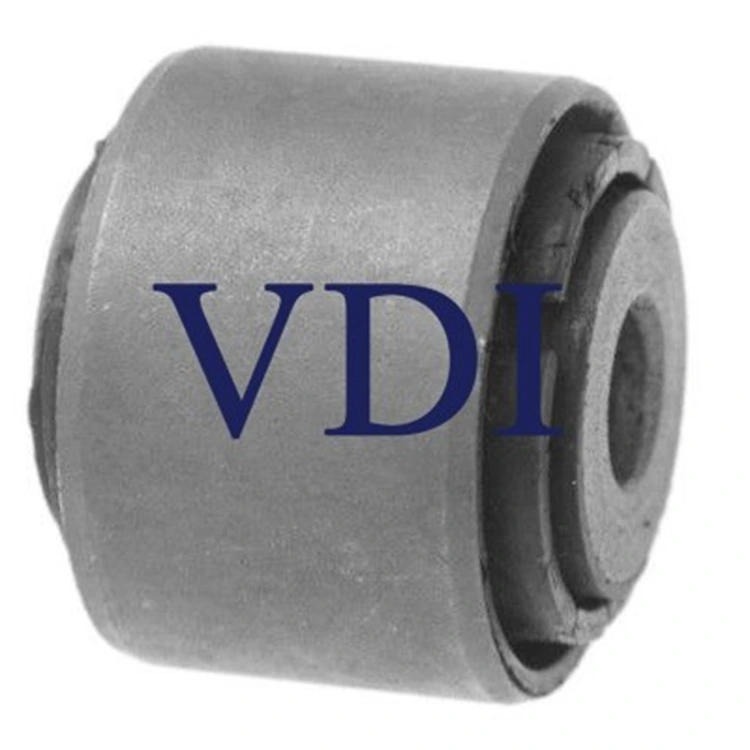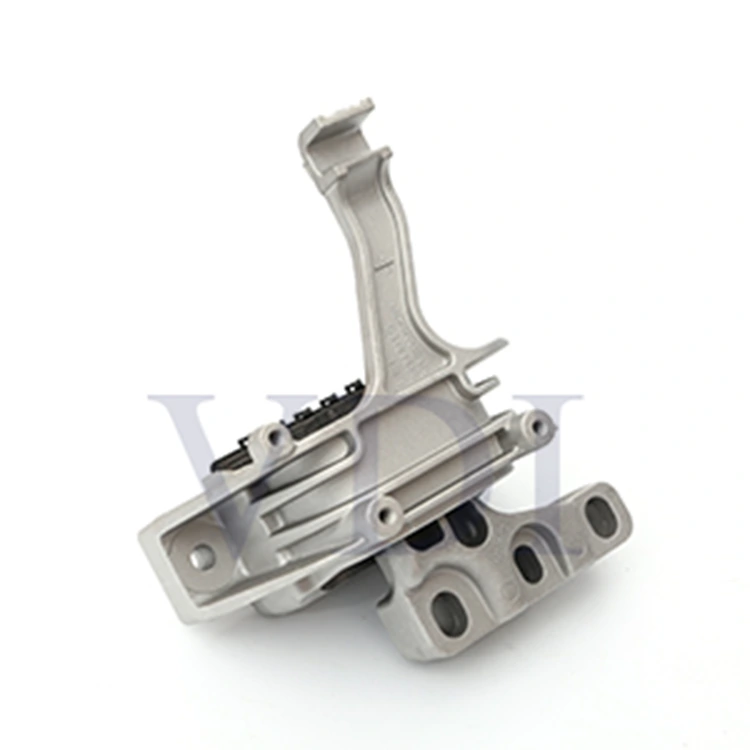

Control arm bushings are far from uniform components( VDI Control Arm Bushing 7L0407182G). Their performance relies heavily on anisotropic stiffness—meaning the material exhibits different mechanical properties depending on the direction of applied force. This directional variation is intentional and essential for balancing ride comfort, handling precision, and suspension durability.
The two primary directions of stiffness are radial (perpendicular to the bushing axis) and axial (along the bushing axis). Radial stiffness is deliberately engineered to be significantly higher. During cornering, lateral acceleration generates substantial side loads on the control arm. High radial stiffness resists these forces, limiting unwanted changes in camber angle (excessive positive or negative tilt of the wheel) and toe angle (inward or outward pointing of the wheel). Without sufficient radial resistance, the tire contact patch would shift unpredictably, reducing grip and causing imprecise steering response.
In comparison, the axial stiffness is deliberately reduced. Vertical inputs from the road—like potholes, expansion joints, or uneven surfaces—necessitate the control arm to rotate and compress in a vertical manner. A flexible axial direction enables the bushing to take in and disperse these impacts by means of deformation, which stops the severe transfer of shock to the chassis and the people inside. Should the axial stiffness be excessively high, the suspension would seem too stiff, relaying every flaw in the road straight into the interior of the vehicle.
This behavior, which varies in different directions, is realized through careful design of geometry instead of depending solely on the characteristics of materials. Common methods include:
●Changing wall thickness: Having sections of rubber that are thinner along the length for flexibility, while having thicker areas along the width for strength.
●Profiles resembling dumbbells or hourglasses: These forms focus material in places where resistance in the radial direction is essential, while also forming thinner areas or gaps in the axial direction.
●Structures with multiple cavities or slots: The presence of inner cavities or slots permits gradual compression along the axial direction (starting soft, then becoming harder as the gaps close), while the outer cylindrical shape preserves strength in the radial direction.
●Design of molds and positioning of inserts: The configuration of the inner metal sleeve, external casing, and the flow of rubber during the vulcanization process are specifically designed to form gradients of stiffness in specific directions.
These designs facilitate advancing axial compression, featuring gentle initial movement for minor obstacles and heightened resistance with greater deflections. They also retain significant radial stiffness to uphold suspension alignment when side forces are applied. Consequently, this results in a bushing that provides vertical flexibility while ensuring lateral stability, thus avoiding issues such as bump steer, which refers to unintended changes in toe over uneven surfaces, or excessive body roll.
In real-life applications, this anisotropy serves as a fundamental element in contemporary suspension adjustments. Designers employ finite element analysis (FEA) to replicate multi-directional forces and refine the bushing design specific to every vehicle model, guaranteeing the intended equilibrium between comfort and stability.VDI Control Arm Bushing 7L0407182G delivers superior quality for a comfortable driving experience.