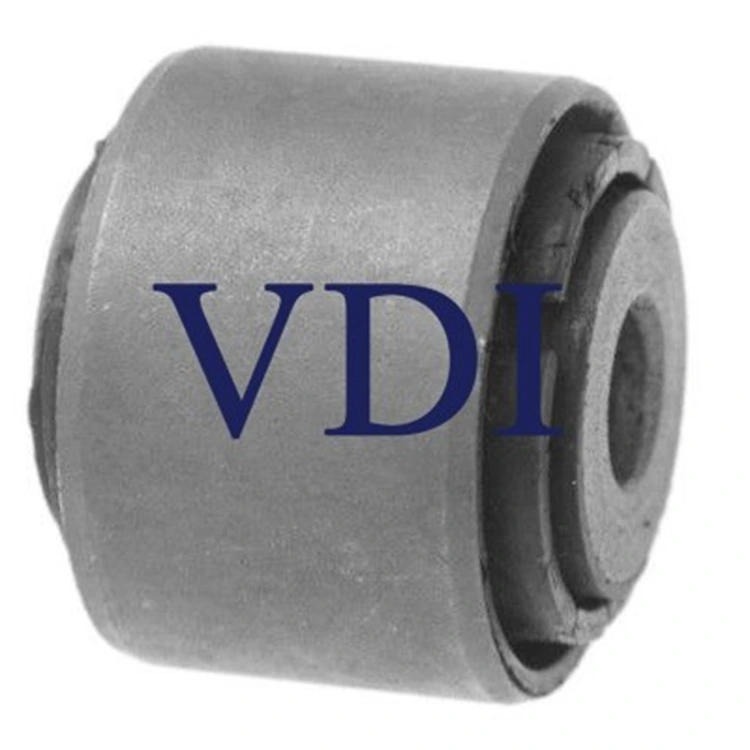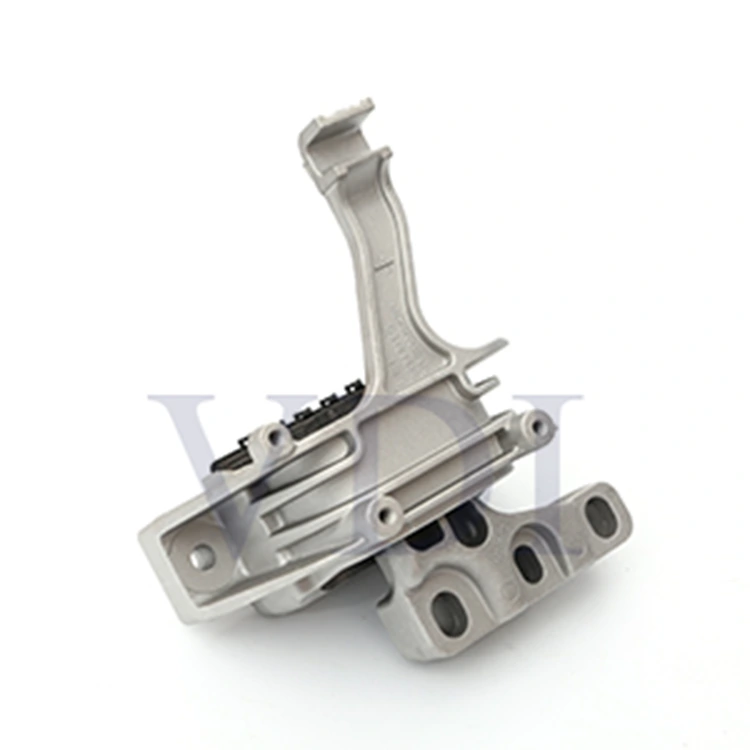

Control arm bushings in real-world vehicle operation are not subjected to static loads, but rather to high-frequency, repetitive dynamic stress cycles. This cyclic loading is the primary cause of the most common bushing failure mode: fatigue failure. The micromechanism of fatigue has been repeatedly validated in numerous papers on rubber mechanics and automotive engineering. At its core, it arises when localized stresses within the material repeatedly exceed the ultimate elongation limit of the rubber polymer chains, ultimately triggering an irreversible progression from microscopic cracks to macroscopic failure.
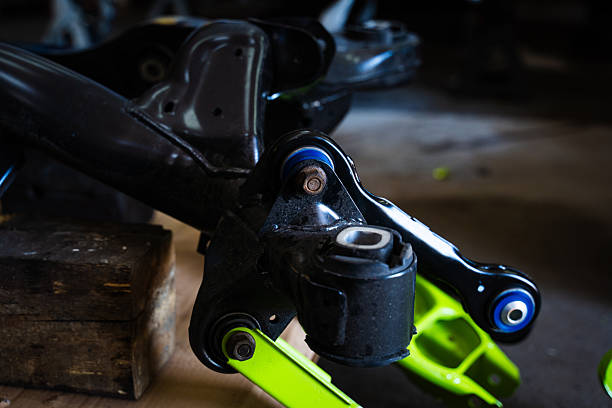
Rubber, as a viscoelastic polymer, undergoes chain disentanglement, orientation, and extension when stretched. When local stress exceeds the material’s ultimate elongation—typically in the range of 50–80% of its tensile break elongation, depending on formulation—the polymer chains experience irreversible slippage, scission, or localized tearing. These micro-damages initially appear as tiny voids or crack nuclei. Under repeated tension-compression cycles, stress concentration at the crack tip further promotes slow crack propagation perpendicular to the principal stress direction. Each cycle incrementally increases crack length; once accumulated to a critical extent, microcracks coalesce into macroscopically visible cracks, eventually leading to bushing tearing, debonding, or complete loss of elastic function. This process follows classic fatigue crack growth laws: crack growth rate correlates with the stress intensity factor range via a power-law relationship, and the material’s ultimate elongation directly sets the threshold for crack initiation. Lower or more uneven elongation results in shorter fatigue life.
In the specific application of control arm bushings, fatigue failure is highly correlated with the complex load spectrum of suspension motion. Longitudinal impacts (e.g., crossing speed bumps), lateral cornering forces, vertical compression (e.g., hitting potholes), and torsion (arm rotation during steering) intertwine to form multiaxial fatigue. Conventional solid rubber bushings under these conditions are most prone to “triaxial stress concentration” in the central region: repeated compression-tension causes localized internal strain to exceed the material’s limit, generating internal microcracks that then propagate outward, forming annular or radial surface cracks. Testing shows that under typical road load spectra (equivalent to 100,000–300,000 km of service), the fatigue life of non-optimized rubber bushings is often limited by this internal micro-damage accumulation—not surface wear.
Hydraulic bushings exhibit unique fatigue failure modes due to their fluid cavity and orifice plate structure. While they deliver low-frequency high damping and high-frequency low dynamic stiffness through fluid flow, they also introduce new physical boundaries. The orifice plate—typically made of metal or engineering plastic—is subjected over time to high-pressure fluid pulses and repeated squeezing from rubber deformation. This can lead to localized wear, distortion, or even micro-cracking of the plate. In early stages, wear blunts the orifice edges, weakening throttling effect and causing damping degradation; in severe cases, the plate fractures or shifts, resulting in fluid leakage. The bushing instantly loses hydraulic functionality and reverts to a standard rubber bushing, with fatigue life plummeting. Real-world cases show many premium-vehicle hydraulic bushings develop abnormal orifice plate wear after 80,000–120,000 km, rooted in designs that underestimated peak fluid pulse pressures and local stress concentrations during rubber compression—exceeding the material’s fatigue limit.
Another typical case is abnormal wear of the bump stop (limit block). Control arm bushings often integrate a rubber bump stop to restrict excessive arm swing and provide cushioning at travel limits. Under full-load braking or extreme off-road conditions, the bump stop endures extremely high compressive strain. Repeated impacts easily induce compression fatigue. Rubber’s ultimate compressive strain is typically far lower than its tensile elongation (molecular chains cannot rearrange freely under compression like in tension). Once local compressive strain exceeds 30–40%, internal cavitation and microcracks form, which then propagate under cyclic loading into surface spalling or chunk fracture. In many multi-link rear suspensions, the bump stop becomes the first failure point under such conditions, causing metal-to-metal impact, noise, and accelerated fatigue in other areas.
The physical boundary of durability is fundamentally determined by three factors: the material’s ultimate elongation, the fatigue crack growth threshold, and stress distribution uniformity. To push beyond these limits, modern designs commonly adopt the following strategies:
● Use finite element analysis (FEA) to accurately predict local strain peaks under multiaxial loads, ensuring peak strain stays below 60% of the material’s ultimate elongation;
● Introduce cavities, notches, or asymmetric geometries to homogenize stress and avoid triaxial concentration;
● Employ high-elongation, low-hysteresis rubber compounds (e.g., with silane coupling agents or nano-fillers to improve chain uniformity);
● Optimize orifice geometry in hydraulic bushings (e.g., larger fillets, wear-resistant coatings) to reduce pulse impact;
● Apply progressive hardness design or polyurethane composites to bump stops to share extreme compression loads.
Experimental validation shows these optimizations can extend bushing fatigue life by 1–3 times, typically pushing service life from 100,000 km to over 250,000 km.
Ultimately, fatigue failure of control arm bushings is not accidental—it is the inevitable result of materials reaching their physical limits under repeated dynamic stress. Ultimate elongation, as an intrinsic property of rubber, sets the threshold for micro-damage initiation, while real-world load spectra, structural design, and material formulation collectively determine when that threshold is breached. Understanding this evolution—from micro to macro—enables engineers to define realistic durability boundaries at the design stage, allowing bushings to approach their theoretical lifespan in complex road environments, rather than degrade prematurely. Welcome to order VDI Control Arm Bushing 7L0407182E!