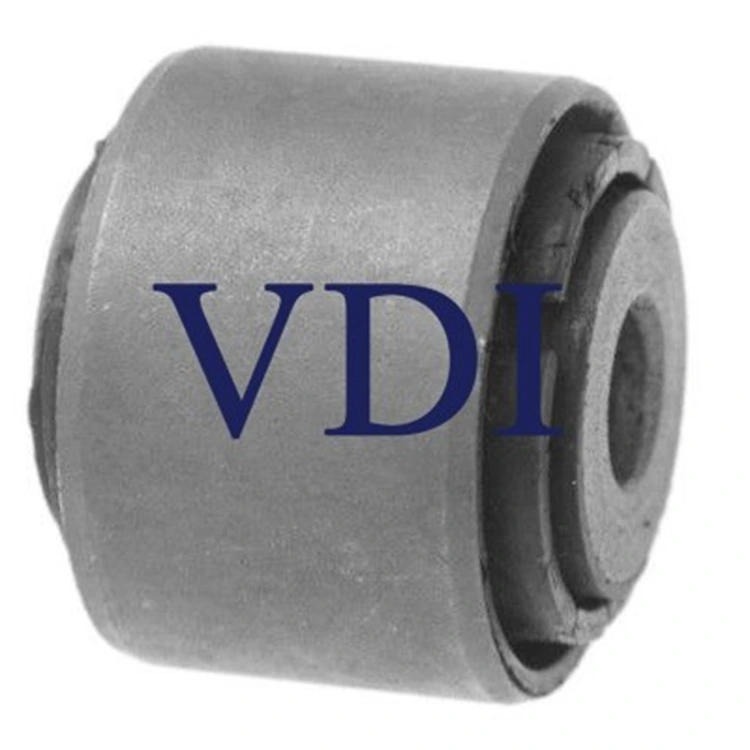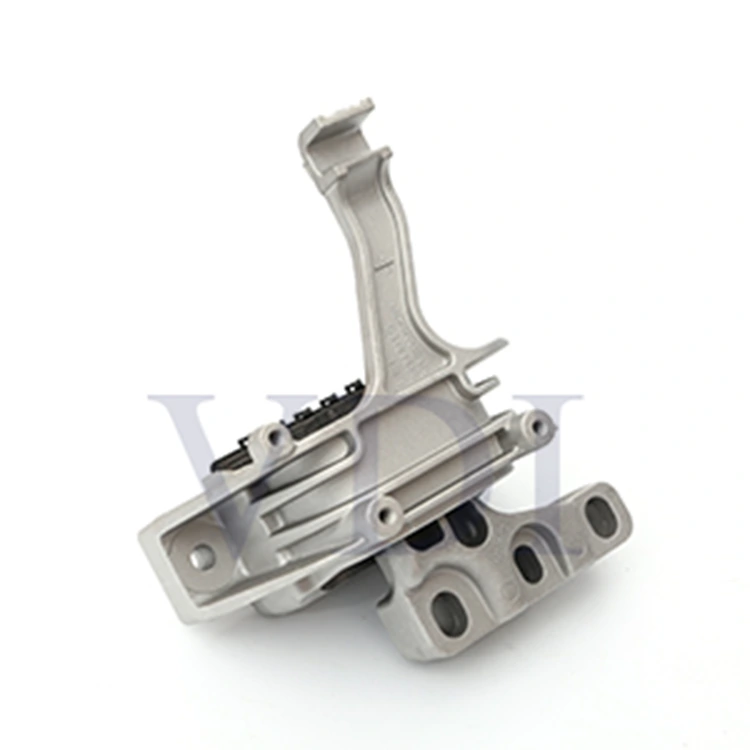

The structural design of control arm bushings has undergone a significant evolution—from simple solid rubber blocks to highly complex composite architectures. The core driver of this transformation lies in the need to simultaneously satisfy three increasingly demanding performance requirements: superior vibration isolation and damping, precise motion limiting, and reliable long-term durability against debonding or tearing( The VDI Control Arm Bushing 357407182 is no exception). Early bushings were typically solid cylindrical or conical rubber bodies that relied solely on the material’s compressive and shear deformation to absorb loads. However, under high-load, multi-axial dynamic conditions, this design was prone to severe stress concentration, leading to premature tearing or permanent set. Modern engineering has overcome these limitations through microstructural innovations—such as strategic combinations of cavities and solid zones, asymmetric cavity layouts, integrated bump stops, and arc-contoured deformation holes—enabling uniform stress distribution, precise control of deformation modes, and a significant delay in failure onset. These design philosophies, extensively documented in automotive chassis patents and technical papers, have now become the standard paradigm for premium suspension bushings.
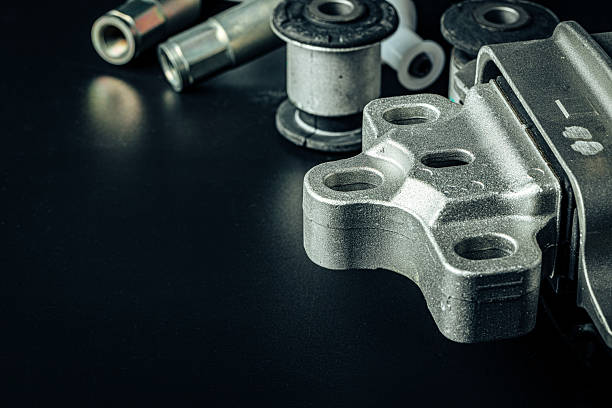
The combination of cavities and solid regions represents the most fundamental yet revolutionary structural advancement in contemporary control arm bushings. In a fully solid rubber bushing, compression induces triaxial stress concentration at the core, where local strain often exceeds the material’s ultimate elongation, triggering cavitation cracks. Under tension or torsion, surface tearing readily occurs at the outer layers. By introducing internal cavities, the rubber body is effectively segmented into multiple semi-independent “solid pillars” or “load-bearing walls.” These solid sections primarily provide radial and torsional stiffness, while the cavities act as “stress-relief zones,” allowing rubber to expand freely into the void during compression—dramatically reducing local peak stresses. Cavities also significantly enhance compliance under low-frequency, large-displacement inputs (e.g., potholes or speed bumps), improving ride comfort, while maintaining sufficient dynamic stiffness under high-frequency, small-amplitude vibrations. Numerous patents explicitly state that by precisely controlling cavity volume ratio (typically 20–40%) and spatial distribution, the maximum Von Mises stress during compression can be reduced by over 30%, effectively delaying fatigue crack initiation.
Asymmetric cavity design takes this concept further toward fine-tuned optimization. Traditional symmetric cavities—such as a central round hole or evenly spaced small holes—improve overall stress but cannot address the inherently asymmetric multi-axial loads experienced by real-world control arm bushings: longitudinal impacts (e.g., braking) are often much larger than lateral cornering forces, while steering introduces directional torsional shear. Asymmetric cavities deliberately offset cavity location, alter cavity shape (e.g., elliptical, crescent, or trapezoidal), or vary cavity depth to selectively soften stiffness in specific directions. For example, in a front lower control arm bushing, a larger cavity is often placed on the forward longitudinal side, allowing rubber to deform more easily into the cavity during braking—thereby lowering longitudinal stiffness to absorb shock. Meanwhile, more solid material is retained laterally to ensure high lateral stiffness for precise steering response. This asymmetric approach enables independent tuning of radial, axial, and torsional stiffness, achieving “directional compliance”: soft in directions where comfort matters, rigid where handling precision is critical.
The integration of bump stops marks another key evolutionary step. Early designs relied entirely on external metal stops or geometric limits on the control arm itself for travel restriction—prone to metal-to-metal impact noise and accelerated wear. Modern bushings directly mold rubber bump stops into the interior or ends of the bushing body, creating a progressive hardness transition. At small arm angles, only the main rubber element deforms for cushioning; as the angle increases beyond a threshold, the bump stop engages and compresses. Its hardness is typically higher than the main rubber, delivering a sharp secondary stiffness rise—realizing a two-stage “soft-then-hard” limiting behavior. This structure eliminates direct metal contact and, through carefully shaped bump stop geometry (e.g., conical or stepped profiles), controls stress distribution during compression to prevent localized over-squeezing and tearing. Engineering studies consistently show that well-designed integrated bump stops can reduce peak stress at full travel by over 40%, significantly extending overall durability.
Arc-contoured deformation holes exemplify microstructural optimization at the finest scale. Traditional cavities with sharp corners or right-angle edges create severe stress concentrations during deformation—local stress at the tip can be several times the average, making it a prime crack initiation site. Arc-contoured holes eliminate this risk by rounding all cavity edges with large fillets (typically 20–50% of the hole diameter) and using smooth S-curve or parabolic transitions at the solid-cavity interface. This allows stress to diffuse uniformly along the curved surface. Finite element analysis (FEA) demonstrates that such arc transitions can reduce peak principal stress at cavity edges by 50–70%, greatly enhancing tear resistance. Additionally, these deformation holes act as “guided flow channels”: under directional compression, rubber preferentially flows into the cavity, further refining compliance and limiting characteristics.
The synergistic application of these microstructural features enables modern control arm bushings to achieve multi-objective co-optimization at the structural level:
● Cavity + solid integration homogenizes global stress;
● Asymmetric cavities enable directional stiffness tuning;
● Integrated bump stops provide safe, progressive travel limitation;
● Arc-contoured transitions prevent localized tearing.
Patents and engineering validation consistently confirm that bushings incorporating these design principles exhibit 1–3× longer fatigue life under identical road load spectra—typically extending service life from 100,000 km to 250,000–300,000+ km—while achieving a superior balance among NVH, handling, and durability. This shift from “passive load bearing” to “active deformation guidance” embodies the core logic of control arm bushing structural evolution—and reflects automotive engineering’s precise mastery of material limits at the micro-scale( Welcome to order VDI Control Arm Bushing 357407182!).