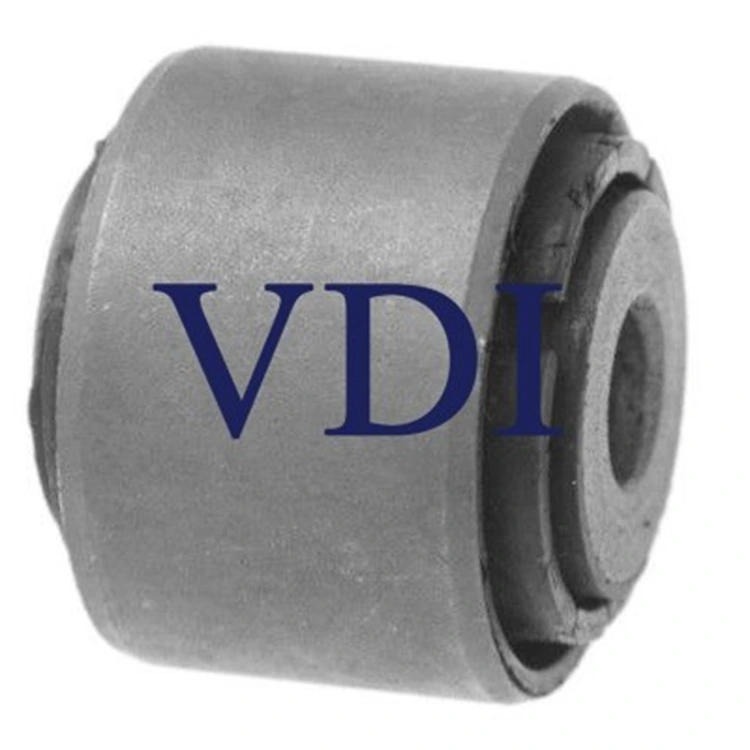

Control arm bushings play a critical role in a vehicle’s suspension system. They are not only elastic connectors but also directly determine the wheel’s motion trajectory relative to the body, the load transfer path, and the vehicle’s overall kinematic and elastokinematic characteristics. Due to differences in structural layout and geometric relationships, various suspension types subject control arm bushings to significantly different proportions of longitudinal, lateral, and vertical loads. This, in turn, imposes distinctly different design requirements on the bushing’s radial stiffness, torsional compliance, and even axial characteristics. This variation is precisely why bushings are not one-size-fits-all: engineers must tailor the bushing’s stiffness curve, damping behavior, and geometry specifically to the suspension type to achieve the optimal balance among handling, ride comfort, and durability( You can also contact us to learn more about the VDI Control Arm Bushing 6Q0407182.).
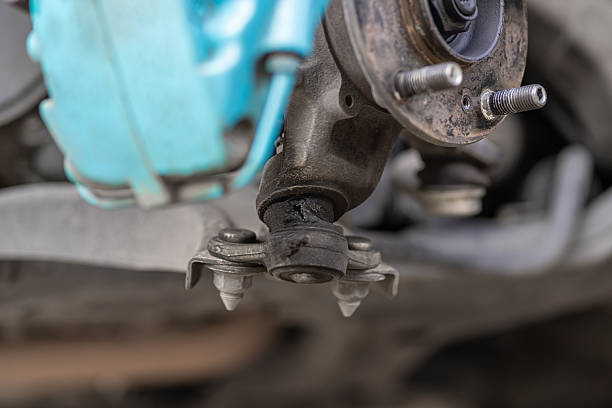
MacPherson strut suspension is the most common entry-level independent suspension, widely used in front axles. Its defining feature is a single lower control arm (typically L- or A-shaped), with the upper end connected directly to the body and steering knuckle via a spring-loaded damper strut. This configuration means the lower control arm bushing must simultaneously carry the majority of longitudinal and lateral loads, plus a portion of vertical loads. In the longitudinal direction, braking or acceleration forces are primarily transmitted through the lower control arm to the bushing mounting point. Longitudinal load often accounts for 40–60% of total load—the highest proportion—since there is no upper arm to share the burden. The bushing must therefore provide sufficient longitudinal compliance to absorb road impacts, yet avoid excessive deformation that could cause uncontrolled toe changes. In the lateral direction, cornering forces are shared between the lower arm and anti-roll bar, making radial stiffness critical: higher radial stiffness is needed to resist lateral displacement, maintain stable camber angles, and prevent excessive body roll or understeer. Vertical loads, however, are relatively low since they are mainly borne by the strut; here, the bushing favors a degree of torsional compliance to accommodate wheel jounce/rebound and rotational motion during steering. Excessive radial stiffness compromises comfort; overly high torsional stiffness increases NVH issues. Thus, MacPherson control arm bushings are typically designed with radial stiffness significantly higher than torsional stiffness—often by a factor of 5 to 10 or more—emphasizing radial rigidity for basic handling stability while fine-tuning torsional compliance via hydraulic or cavity structures to enhance vibration isolation.
Double wishbone suspension represents a higher-performance classic solution, used on both front and rear axles. It features an upper and a lower A-arm, forming a near-parallelogram geometry. This layout enables more balanced load distribution: longitudinal loads (from braking/acceleration) are primarily handled by the lower arm, but the upper arm also shares part of the load, reducing the longitudinal proportion to 30–40%—much lower than in MacPherson. Lateral loads are efficiently resisted by both arms, distributing cornering forces evenly and resulting in lower lateral load per bushing. Vertical loads are similarly shared between upper and lower arms, leading to more uniform stress. The key advantage of this geometry is precise wheel motion control, which dramatically increases the demand for torsional compliance: both arms must allow significant angular twist during wheel travel to achieve ideal parallel motion and controlled camber gain. Radial stiffness, meanwhile, should remain moderately high to prevent excessive elastic deformation from disturbing alignment parameters. Double wishbone bushings are thus characterized by lower torsional stiffness relative to radial stiffness—typically a ratio of 1:1 to 1:3—and often employ asymmetric designs or hydraulic bushings to further soften torsional response while reinforcing radial rigidity for lateral stability. This enables superior performance under aggressive driving: better roll control, more stable toe/camber behavior—but also demands higher fatigue resistance and precise dynamic characteristics from the bushing.
Multi-link suspension is the most flexible and complex independent suspension architecture, typically using three to five separate links on the rear axle (and sometimes hybrid configurations on the front). It assigns different degrees of freedom to dedicated links—including upper control arms, lower control arms, trailing arms, etc.—achieving highly decoupled load paths. Longitudinal loads are usually managed by dedicated trailing or longitudinal arms, so the control arm bushing’s longitudinal load share is the lowest—often below 20–30%—thanks to load diversion by independent members. Lateral loads are distributed across multiple transverse links, with each bushing bearing only localized side forces, resulting in even lower individual load ratios. Vertical loads are likewise shared among multiple mounting points, keeping peak stresses low. This high level of functional decoupling allows each control arm bushing to serve a highly specialized role: some positions (e.g., front lower arm or trailing arm bushings) prioritize radial stiffness to resist lateral/longitudinal shocks and maintain geometric precision; others (e.g., upper arm or toe-control link bushings) require extremely high torsional compliance to permit natural wheel twist and toe change during jounce, enabling “passive rear steering” effects. The radial-to-torsional stiffness ratio in multi-link systems varies drastically by link function—some favor high radial stiffness, others dominate in torsional flexibility. This “role-specific” approach grants multi-link suspensions an exceptionally wide tuning range between comfort and handling, but it also means bushing design must be highly customized: bushings at different locations on the same vehicle can differ significantly—even in material composition and internal structure.
MacPherson suspension forces the control arm bushing to act as a “jack-of-all-trades,” with high longitudinal and radial load shares, relying heavily on radial stiffness for baseline stability; double wishbone reduces bushing burden through dual-arm load sharing, placing greater emphasis on torsional compliance for precise kinematics; multi-link fully decentralizes loads, assigning each bushing a specialized function where radial or torsional demands vary by position. This fundamental difference in loading and functional requirements directly explains why bushings are not interchangeable generic parts. Engineers must select or design each bushing based on the specific suspension geometry, load spectrum, and performance targets—deciding whether to prioritize radial stiffness (for roll resistance and alignment retention), torsional compliance (for vibration filtering and articulation), or a balanced compromise—so that the same bushing model can exhibit completely different “personalities” when installed in different suspension architectures. Welcome to order VDI Control Arm Bushing 6Q0407182!