
Many vehicle owners report after replacing a Stabilizer Link:
“The steering feels heavier,” “The wheel doesn’t return to center as smoothly,” or “The car feels floaty at highway speeds.”
Technicians often inspect the steering system and perform wheel alignments—only to find no faults—while overlooking one hidden variable: the preload state of the Stabilizer Link.
In the suspension system, the Stabilizer Link is not merely a “connector”—it acts as the “switch” for anti-roll bar torque transmission. If installed with non-design preload, it directly disrupts the vehicle’s lateral force balance, thereby altering the driving experience.
This is especially important for precision applications like the Volkswagen Stabilizer Link, as even slight preload can amplify noise, vibration, and harshness (NVH) issues due to its location near the passenger cabin.
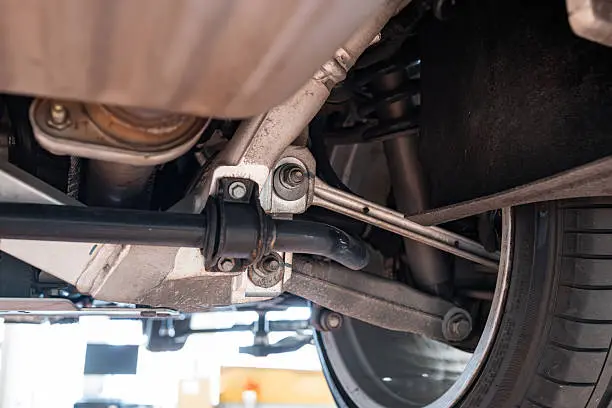
▶ Definition
Preload refers to whether the Stabilizer Link is subjected to tensile or compressive force when the vehicle is:
●Static
●At curb weight
●With suspension at normal ride height
●Ideal state: Preload = 0 → The link engages only during dynamic body roll
●Non-ideal state: Preload ≠ 0 → The link is “always on,” continuously applying counter-force to the suspension
Engineering Significance
The anti-roll bar system is designed to intervene only when the body rolls. If the Stabilizer Link has preload, it’s like pre-activating the stabilizer bar, causing:
●Abnormally increased suspension stiffness
●Shifted tire contact patch pressure distribution
●Increased steering system load
Analogy: It’s like adding a spring to your bicycle that’s always taut—even when riding straight, you must exert extra effort.
This principle applies equally to front and rear Stabilizer Bar Assembly systems, though rear links are more sensitive to NVH due to proximity to cabin mounts.
1. Heavier or “Stiff” Steering Feel
Even during straight-line driving, the anti-roll bar transmits lateral force through a preloaded Stabilizer Link to the control arm, increasing tie rod load.
●User perception: Steering feels heavy during low-speed maneuvers
●Test data: A 50 N preload can increase steering effort by 8%–12%
2. Delayed Steering Self-Centering
In a healthy vehicle, the steering wheel should automatically return to center after a turn. But excessive preload causes the anti-roll bar to “hold back” the outer suspension, resisting self-aligning torque.
●Typical scenario: After a 90° turn, manual correction is needed
●Impact: Increases driver fatigue and reduces emergency evasion responsiveness
3. Abnormal Tire Wear (Even with “Good” Alignment)
Preload creates asymmetric suspension loads. Even if alignment readings are within spec, the tire contact patch shifts.
●Wear pattern: Continuous block wear on one shoulder (not feathered)
●Case study: A dealership reported six vehicles with identical one-sided tire wear within 3 months of Stabilizer Link replacement. Root cause: link length tolerance + preload from improper installation
Root Cause 1: Incorrect Installation (Most Common)
●Mistake: Fully torquing bolts while the vehicle is on a lift (suspension fully extended)
●Result: After lowering, the suspension compresses, forcing the link into compression → compressive preload
●Correct procedure: Snug bolts (do not torque)
●Lower the vehicle and pump the brakes to settle suspension
●Final-torque to OEM spec at ride height
Volkswagen’s ElsaPro service manual explicitly states: “Torque bolts only at ride height.”
This is non-negotiable for parts like Stabilizer Link 1K0505465, which has minimal tolerance for misalignment.
Root Cause 2: Excessive Length Tolerance
●Budget aftermarket links often have ±1.0 mm length tolerance
●OE-grade parts control tolerance to ≤±0.3 mm
●Impact: Just 0.8 mm of deviation can induce 30–40 N of preload on MQB platforms
Root Cause 3: Subframe or Body Misalignment
●After an accident, uncorrected subframe deformation causes asymmetric Stabilizer Bar Assembly mounting points
●Even a perfect Stabilizer Link will develop preload due to shifted geometry
●Diagnostic tip: Measure installed length of left/right links—if mismatched by >0.5 mm, suspect structural misalignment
1. Precision Manufacturing: Tight Length Control
Brands like VDI and Mevotech use CNC laser length measurement + automatic binning to ensure left/right pair length difference is ≤0.2 mm—critical for balanced performance in systems like the rear Stabilizer Bar Assembly using Stabilizer Link 1K0505465.
2. Adjustable Designs (Performance Models Only)
●BMW M and Audi RS models use threaded-body Stabilizer Links
●Technicians can fine-tune length to actively set preload for track tuning
●Example: Slight tensile preload enhances initial steering response (at the cost of comfort)
3. OE-Level Simulation Validation
OEMs use ADAMS/Car or SIMPACK in the design phase to optimize Stabilizer Link length, ensuring:
●Zero preload at curb weight
●Linear torque transfer during dynamic roll
●No interference under extreme conditions
It doesn’t change hardware—but it subtly shapes the vehicle’s “personality”:
Is it a smooth commuter—or a sharp handler?
●For engineers, it’s the balance point between NVH and agility
●For technicians, it’s the key checkpoint to prevent comebacks
●For brands, it’s the threshold that separates “functional” from “refined”
Remember: True chassis sophistication lies in 0.3 mm of tolerance—and in the engineering philosophy of “zero preload, perfect balance.”
And when you replace a Stabilizer Link 1K0505465, you’re not just installing a part—you’re preserving the harmony of the entire Stabilizer Bar Assembly. Welcome to purchase the VDI Stabilizer Link 1K0505465.