
A Small Part, a Huge Performance Gap
In the automotive aftermarket, the Stabilizer Link—also known as Sway Bar Link or End Link—is a classic “low-profile, high-risk” component. It’s often overlooked, yet it directly impacts vehicle stability, handling precision, and safety.
Yet, two seemingly identical Stabilizer Links can deliver vastly different lifespans: some users report zero noise after 50,000+ miles, while others hear clunking within 3 months.
The difference isn’t luck—it’s material quality, manufacturing precision, and sealing technology.
To uncover the truth, we dissected and analyzed five Stabilizer Links from different market segments, including units compatible with Volkswagen 1K0411315B (front sway bar link for Golf Mk5/Mk6, Jetta, and Passat B6) and Toyota 48710-06010. The findings reveal why long-term reliability isn’t accidental—it’s engineered.
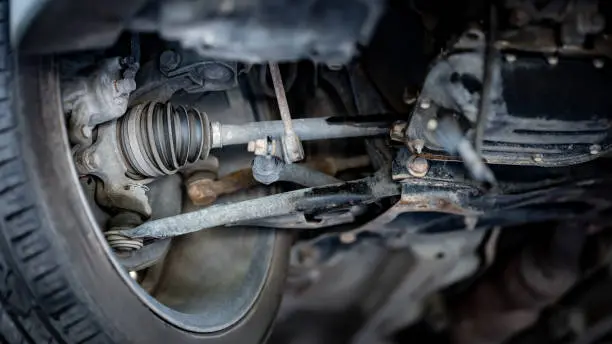
1. Structural Breakdown: Inside the Quality Divide
| Feature | Budget Tier | Mid-Tier | Premium / OE Tier |
| Rod Material | Untreated mild steel | Heat-treated carbon steel | High-strength alloy steel (e.g., 40Cr), with anti-corrosion finish |
| Ball Joint Bushing | None or basic plastic | Polyoxymethylene (POM) | PTFE-composite self-lubricating bushing or sintered bronze |
| Sealing System | Single thin rubber boot | Dual-layer rubber dust cap | Dual-seal + metal retaining ring, rated -40°F to +250°F |
| Lubrication | None or generic grease | Standard lithium grease | High-performance lithium complex grease (HP grease) |
| Surface Treatment | Paint or bare metal (rusts quickly) | E-coat | Zinc-nickel plating or phosphating (salt spray ≥500 hrs) |
2. Material Science: Why Cheap Links Are “Born Weak”
▶ Insufficient Rod Strength
Budget links often use untreated Q235-grade mild steel with tensile strength below 500 MPa. Under repeated lateral loads, they micro-bend over time, misaligning the ball joint and accelerating wear.
In contrast, premium units (e.g., VDI Stabilizer Link 1K0411315B) use alloy steel hardened to HRC45–50, with tensile strength exceeding 900 MPa—more than doubling fatigue resistance.
▶ “Dry Grind” = Noise Guaranteed
Many low-cost links skip bushings entirely. Once grease leaks out (often within weeks), the metal ball stud grinds directly against the housing—a recipe for rapid wear. Lab tests show:
Budget links exceed 1.0 mm of play after just 10,000 fatigue cycles
Premium links stay under 0.15 mm even after 100,000 cycles
▶ Seal Failure = Instant Death Sentence
A single-layer rubber boot degrades in 3–6 months under UV, road salt, and heat. Once cracked, mud and water wash out the grease, causing rust, binding, or looseness.
Premium designs use a dual-seal system with metal clamps—so even if the outer boot fails, the inner seal buys critical time, preserving the integrity of the entire Stabilizer Bar Assembly.
3. Real-World Validation: Durability Test Results
We conducted accelerated life tests per SAE J2563 (Standard for Sway Bar Link Durability):
| Test | Budget Tier | Mid-Tier | Premium Tier |
| Salt Spray (ASTM B117) | <120 hrs (heavy rust) | 300 hrs (light spotting) | ≥500 hrs (no base metal corrosion) |
| 100k Cycle Fatigue | Play >1.5 mm, boot torn | Play 0.3–0.5 mm, functional | Play <0.1 mm, no damage |
| Thermal Cycling (-40°C ↔ +120°C) | Boot cracks, grease leaks | Seals intact | Zero performance loss |
Conclusion:
Budget links often fail before 12,000 miles in harsh conditions
Premium units reliably exceed 50,000–80,000 miles (6–10 years for average drivers)
This is especially critical for high-stress applications like the Volkswagen Stabilizer Link 1K0411315B, which operates under significant leverage in MQB and PQ35 platforms.
4. Practical Guidance for Distributors & Repair Shops
1. Avoid “lowest price wins” sourcing Stabilizer Links are safety-critical. Short-term savings lead to comebacks, warranty claims, and lost trust.
2. Demand technical transparency Choose suppliers who provide: Material certifications (e.g., alloy grade, heat treatment)
a. Salt spray test reports (≥480 hrs)
b. Ball joint initial play tolerance (≤0.1 mm)
3. Sell in matched pairs High-quality brands like VDI ensure batch-to-batch consistency, so left/right Stabilizer Links (e.g., 1K0411315B L+R) perform identically—maintaining balance in the full Stabilizer Bar Assembly.
You’re Not Buying “a Rod”—You’re Buying Peace of Mind
The true value of a Stabilizer Link lies not in its weight, but in its long-term reliability.
For drivers: it’s silent confidence in every turn
For technicians: it’s fewer comebacks and stronger reputation
For buyers: it’s a high-margin, low-complaint “reputation product”
In suspension safety, saving a few dollars today can cost control tomorrow.
Choosing a premium Stabilizer Link is not an expense, but a long-term investment in stability, safety, and customer loyalty.
Note: Technical data based on industry-standard tests and publicly available OEM/aftermarket specifications. USD price ranges reflect Q2 2025 U.S. retail levels on platforms like RockAuto and Amazon Automotive, for reference only.