
Many drivers hear a “clunk… clunk…” noise from the front wheels when going over speed bumps, manhole covers, or rough roads—and their first thought is: “Is my shock absorber leaking?”
But any seasoned chassis technician with 10+ years of experience will tell you: “8 out of 10 times, it’s the Stabilizer Link that’s worn out.”
Don’t underestimate this short metal rod—shorter than your palm. The moment it fails, your car’s entire “structural integrity” falls apart.
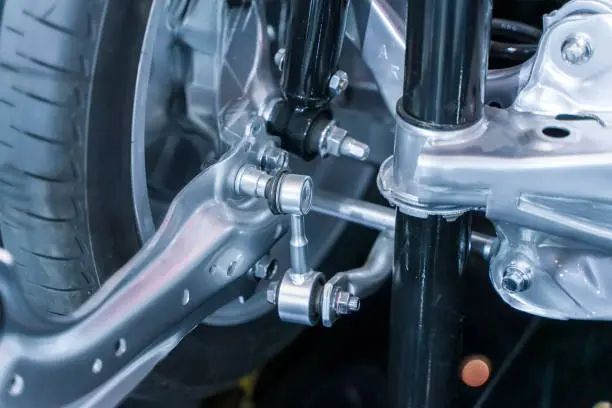
A Stabilizer Link—also known in the U.S. and Europe as a Sway Bar Link or End Link—is a small metal rod, typically 4 to 8 inches (10–20 cm) long, with a ball joint on each end. One side connects to the sway bar (anti-roll bar), and the other attaches to the lower control arm or strut mount. It is a critical component of the complete Stabilizer Bar Assembly, which includes the sway bar itself and both left/right links. Despite its simple design, its role is critical:
When your car takes a high-speed turn, the outside suspension compresses while the inside extends, causing the body to lean outward. At this moment, the sway bar uses the Stabilizer Link to “tie” the left and right suspensions together, resisting this body roll.
In simple terms: It’s the hidden backbone that keeps your car from feeling “floaty,” “wobbly,” or “tippy.”
Without it—or if it’s already loose or worn—cornering feels like sailing a boat: vague steering, excessive body lean, and drastically reduced tire grip. The risk is especially high in rain or during sudden lane changes. If needed, you are welcome to purchase the VDI Stabilizer Link 1J0411315C.
This tiny link is the “workhorse” of your suspension. Every day, it endures:
●High-frequency vibration: Each bump makes the ball joint oscillate hundreds or thousands of times
●Lateral stress: Constant side loads during turns and lane changes
●Environmental damage: Mud, road salt, extreme heat, and UV exposure
And low-quality parts only make things worse:
●Made from recycled scrap metal—too soft, bends easily
●Skipped heat treatment, leading to low fatigue strength and less than 1/3 the lifespan of OEM parts
●Cheap dust caps—thin rubber or even no seal at all—causing grease to leak out fast
Once the dust cap cracks, dirt and water get inside the ball joint. Lubrication fails, metal grinds against metal—and wear accelerates exponentially. In just a few months, play can go from 0.1 mm to over 1 mm, and that clunking noise shows up.
“Fall apart” doesn’t mean parts fly off—it means your vehicle’s dynamic stability collapses. Symptoms include:
✅ “Floaty” cornering: Steering feels slow to return, body roll gets noticeably worse
✅ Lane-change “wobble”: Rear end feels loose or slightly unstable at highway speeds
✅ Frequent clunking: Audible “clunk” when driving slowly over bumps, turning, or braking—especially noticeable when the car is cold
✅ Uneven tire wear: Suspension misalignment causes scalloped or feathered wear on inner/outer tire edges
✅ Secondary damage: A failed link overloads other parts—like control arm bushings, strut mounts, even tie rods—speeding up their wear
A shop owner in Guangzhou once shared: “We installed a batch of cheap Sway Bar Links last year—35% came back within 3 months. Customers said, ‘It still clunks after replacement.’ Every time, the ball joint was loose again.”
1. Inspect regularly: Check your Stabilizer Link every 12,000 miles (20,000 km) or at the first sign of noise. Lift the vehicle and look for excess play in the ball joint or cracks in the dust cap.
2. Always replace in pairs: Never replace just one side! Left and right links must be swapped together—or suspension forces become unbalanced, cutting the new part’s life short.
3. Choose quality: Go for high-quality Stabilizer Links (sold individually, not as part of a full Stabilizer Bar Assembly) with OE number cross-reference, intact dust seals, smooth rod finish, and properly heat-treated materials. Brands like VDI, which specialize in suspension components, use high-strength alloy materials, dual-seal design, and high-temperature, long-life grease—proven reliable for over 50,000 miles (80,000 km) in Eastern Europe and Southeast Asia.
The Stabilizer Link may be small—but it’s a safety-critical part, not a consumable.
●For drivers: It’s your peace of mind in every turn
●For technicians: It’s the key to avoiding comebacks
●For buyers & distributors: It’s a “reputation product” that builds customer trust
Stop thinking of it as a “cheap little rod.”
What you’re replacing isn’t just a part—it’s your car’s “anchor of stability.” Welcome to purchase the VDI Stabilizer Link 1J0411315C.